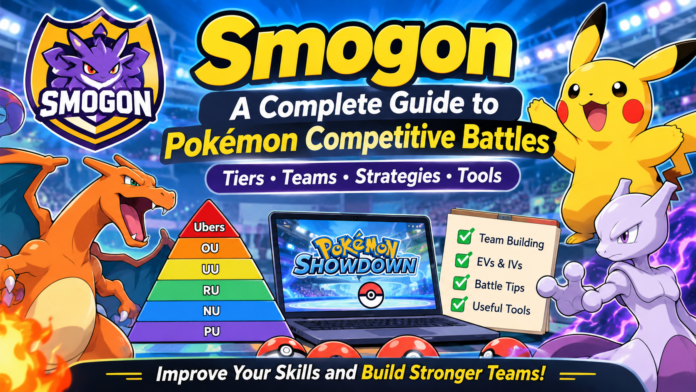


Smogon: A Complete Guide to Pokémon Competitive Battles
Pokémon is not only about collecting creatures, exploring regions and completing the Pokédex. Competitive battling adds another level of strategy, where every move, team choice and decision can influence the result. Smogon is a well-known competitive Pokémon community that helps players understand this side of the game.
Smogon provides detailed Pokémon analyses, competitive tier lists, strategy guides, battle discussions and resources for different formats. Players can use these materials to learn which Pokémon work well together, understand popular strategies and prepare for different opponents.
Whether you are new to competitive Pokémon or already have battle experience, Smogon can help you improve your knowledge. This guide explains how Smogon works, how its tier system is organised, how to build a team and how to use practical tools to become a better player.
1. What Is Smogon and How Does It Work?
Smogon is an independent community dedicated to competitive Pokémon battling. It offers information about Pokémon, moves, abilities, held items, team building and battle strategies. Its website also includes competitive discussions, usage information and resources for different Pokémon generations.
One of Smogon’s main purposes is to make competitive battling more organised. Players can study a Pokémon before using it instead of choosing a team without understanding how its members work together. This makes it easier to prepare for common threats and develop effective strategies.
Smogon is especially known for its six-versus-six Singles formats. In these battles, each player prepares a team of six Pokémon and sends them into battle one at a time. However, Smogon also supports other environments, including Doubles and Little Cup, which have separate rules and competitive communities.
Main Resources Available on Smogon
- Pokémon analyses: Explain recommended moves, abilities, items, EV spreads and competitive roles.
- Tier lists: Show how Pokémon are organised into different competitive environments.
- Strategy guides: Help players understand battle mechanics and team-building methods.
- Usage statistics: Provide information about commonly used Pokémon, moves, items and other competitive choices.
- Community forums: Allow players to discuss strategies, share teams and ask questions.
- Sample teams: Give beginners examples of teams they can study and practise with.
Smogon is not an official Pokémon tournament authority. It is an independent competitive community with its own formats and rules. Its standard Singles formats should not be confused with official Video Game Championships, which follow separate competition regulations.
2. Understanding Smogon Tiers, Usage Statistics and Metagames
The Smogon tier system helps organise Pokémon into different competitive environments. These tiers make it easier for players to compete with Pokémon that are commonly used at similar levels of competitive play.
The main usage-based Singles tiers include Ubers, OverUsed, UnderUsed, RarelyUsed, NeverUsed and PU. Each has its own competitive environment and rules. However, a Pokémon’s tier does not automatically determine how powerful or useful it can be in every battle.
Main Smogon Singles Tiers
| Tier | Meaning | Explanation |
|---|---|---|
| Ubers | Ubers | A separate high-level format that also serves as the banlist for standard OU. |
| OU | OverUsed | A major standard Singles tier with commonly used Pokémon. |
| UU | UnderUsed | A separate competitive tier below OU. |
| RU | RarelyUsed | A lower usage-based Singles tier. |
| NU | NeverUsed | A lower usage-based competitive environment. |
| PU | PU | A lower usage-based tier with its own rules and banlist. |
There are also banlists such as UUBL, RUBL, NUBL and PUBL. These are not ordinary playable tiers in the same way as OU or UU. They contain Pokémon considered too powerful for the corresponding lower tier. The exact restrictions depend on the generation and format.
How Do Usage Statistics Work?
Smogon uses Pokémon usage as its main metric for organising the standard Singles tiers. Usage statistics show how frequently Pokémon appear in battles on particular competitive ladders. These statistics help identify which Pokémon are common threats in each environment.
Tier calculations use weighted usage data, and the standard tiering process is reviewed periodically. However, usage is not the only factor involved in competitive balance. Smogon can also restrict a Pokémon or strategy if it is considered unhealthy or too powerful for a particular format.
What Is a Metagame?
A metagame is the competitive environment created by the Pokémon, moves, items and strategies players commonly use. It changes as players discover new combinations, develop counters and adjust their teams.
For example, imagine that a particular fast attacker becomes popular in OU. Players may start using defensive Pokémon that can handle it. Other players may then create teams that take advantage of those defensive choices. These changes influence which Pokémon and strategies become popular.
A lower-tier Pokémon can also be useful in a higher tier if it provides something that a team needs. A Pokémon might have a valuable ability, a useful defensive type or a move that helps against a common opponent. Therefore, a lower tier does not automatically mean a Pokémon is weak.
Smogon also organises formats such as Little Cup and Doubles separately from the main Singles tiers. Little Cup focuses on eligible unevolved Pokémon, generally battling at level 5. Doubles involves two active Pokémon on each side, creating different strategic possibilities.
You can learn more about the tier system through Smogon’s official,
3. Pokémon Showdown, Smogon Strategy Dex and Competitive Tools
Smogon provides useful information, but players also need ways to practise and test their ideas. Several online tools make competitive Pokémon easier to understand, especially for beginners who do not yet have a complete team in the main games.
Pokémon Showdown
Pokémon Showdown is an online Pokémon battle simulator. It allows players to create teams, select a competitive format and battle other users. Players can test different movesets, items and Pokémon combinations without first collecting every Pokémon in a main-series game.
For example, a beginner can create a team for an OU format and play several matches. After each battle, they can identify which Pokémon caused problems and decide whether their team needs a different defensive option or more speed control.
Pokémon Showdown is particularly useful because it makes experimentation quick. Players can learn from different opponents, practise switching and understand how competitive rules work.
Smogon Strategy Dex
The Smogon Strategy Dex is a collection of competitive Pokémon analyses. These guides explain how individual Pokémon can be used in particular formats. They commonly include recommended moves, abilities, items, EV spreads, natures and strategic advice.
For example, if you want to use a defensive Pokémon, its analysis may explain which moves help it support teammates and which opponents it can handle. This gives you a starting point for building a team around that Pokémon.
Pokémon Damage Calculator
The Pokémon Showdown Damage Calculator helps players estimate the damage an attack may deal. It is useful for checking whether an attack can knock out an opponent or whether a Pokémon can survive a particular move.
To use it, select the attacking Pokémon and the defending Pokémon. Enter relevant details such as levels, moves, items, abilities, natures and EVs. The calculator then displays an estimated damage range based on the selected battle conditions.
For example, suppose your Pokémon needs to survive an opposing physical attack. You can enter the opponent’s attack and your Pokémon’s defensive details to check whether additional HP or Defense investment could improve the matchup.
These tools work well together. You can study a Pokémon in the Strategy Dex, create a team in Pokémon Showdown and use the Damage Calculator to examine important matchups.
4. How to Build a Strong Smogon Pokémon Team
Building a competitive team is more complicated than choosing six powerful Pokémon. Every team member should have a useful role, and the complete team should be able to handle different types of opponents.
A good team needs a balance of offensive pressure, defensive support, speed control and type coverage. Its structure should also match the selected format. A team designed for standard Singles may not work well in Doubles because the battle mechanics and strategic priorities are different.
Understand Different Pokémon Roles
Before selecting your Pokémon, learn the purpose of common competitive roles.
- Physical attacker: Deals damage using physical moves and its Attack stat.
- Special attacker: Uses special moves and Special Attack to pressure opponents.
- Physical wall: Helps absorb physical attacks and protect teammates.
- Special wall: Provides protection against special attackers.
- Sweeper: Attempts to defeat multiple opponents after gaining a favourable position.
- Support Pokémon: Helps teammates through useful moves, abilities or status effects.
- Hazard setter: Places entry hazards that affect opposing Pokémon when they switch in.
- Pivot: Uses moves or abilities that help it switch while maintaining momentum.
A team does not need a separate Pokémon for every role. Some Pokémon can perform several jobs, depending on their moves, abilities and stat investments.
Learn EVs IVs and Natures
EVs, IVs and natures are important parts of competitive Pokémon because they influence a Pokémon’s final stats.
Effort Values (EVs) are points that players allocate to improve a Pokémon’s stats. These include HP, Attack, Defense, Special Attack, Special Defense and Speed. A suitable EV spread can help a Pokémon survive an attack, move faster than a particular opponent or deal more damage.
In many modern competitive formats, players commonly use a spread such as 252 EVs in a main attacking stat, 252 in Speed and 4 in another stat. However, this is only a starting example. More advanced spreads are often designed around specific damage calculations and speed targets.
Individual Values (IVs) are hidden values that contribute to a Pokémon’s stats. They affect the final stat calculations, so players sometimes adjust them to support particular strategies. For example, a Pokémon designed for Trick Room may benefit from a lower Speed IV because Trick Room allows slower Pokémon to move before faster ones under its effect.
Natures can increase one stat while lowering another, with certain natures having no stat changes. A fast attacker may use a nature that improves Speed, while a defensive Pokémon may prefer a nature that increases one of its defensive stats.
The best combination depends on the Pokémon, generation, format and role. Smogon’s analyses provide useful suggested spreads, but players can adjust them when they have a clear reason.
Example of a Balanced Team Structure
Imagine you are building a standard Singles team. You could begin with a physical attacker that puts pressure on opponents. Then you might add a special attacker to avoid relying entirely on physical damage.
Next, consider a defensive Pokémon that can handle threats against your attackers. Add a hazard setter to create pressure when opponents switch, and consider a hazard remover if your team is vulnerable to entry hazards. Your final slot could provide speed control, extra defensive support or another offensive option.
This is an example of a team structure, not a guaranteed winning combination. The actual Pokémon should be selected according to the format, current metagame and weaknesses of the team.
Check Your Team’s Weaknesses
After building a team, review its type matchups and defensive options. If several members share the same weakness, an opponent may be able to exploit that weakness with one strong attack.
For example, imagine that three Pokémon on your team are weak to Ground-type attacks. You may need a teammate with a suitable immunity, resistance or defensive ability. You should also check whether your team can deal with common attackers, entry hazards and defensive strategies.
Test your team in battles and pay attention to repeated problems. If the same opponent or strategy causes difficulty in several matches, consider adjusting your team rather than making random changes after every loss.
5. Important Competitive Pokémon Strategies
Competitive battling involves planning, patience and understanding how different moves affect the game. Choosing a powerful attack is not always the best decision. Sometimes switching, setting hazards or predicting an opponent’s move can create a stronger advantage.
Type Matchups and Switching
Type matchups influence the damage an attack can deal. A super-effective move can put an opposing Pokémon under serious pressure, while a resistant Pokémon may be able to handle that attack more comfortably.
Switching allows players to bring in a teammate with a better matchup. However, switching also gives the opponent an opportunity to make a move. Before switching, consider whether the incoming Pokémon can safely handle the expected attack.
Entry Hazards
Entry hazards affect opposing Pokémon when they enter the battlefield. Common examples include Stealth Rock, Spikes and Toxic Spikes in formats where these moves are permitted.
Stealth Rock damages a Pokémon when it switches in, with the amount of damage influenced by its type effectiveness against Rock. Spikes affect grounded Pokémon, while Toxic Spikes can poison eligible grounded Pokémon.
These moves can gradually weaken an opposing team and make it easier to secure knockouts. Some Pokémon can remove entry hazards through moves such as Rapid Spin or Defog, depending on the generation and format.
Status Conditions
Status conditions can change the direction of a battle. Burn, paralysis, poison and sleep can affect a Pokémon’s ability to attack, move or remain on the field.
For example, burn reduces the physical damage of many affected attackers, while paralysis can reduce Speed and sometimes prevent a Pokémon from moving. Poison can gradually reduce HP, making it difficult for a Pokémon to remain in battle.
Players should consider which opponent would be most affected before using a status move. Applying a status condition to the right target can create opportunities for the rest of the team.
Prediction and Setup Moves
Prediction means thinking about what an opponent may do and selecting a move that takes advantage of their possible decision. A player might expect an opponent to switch and use that opportunity to attack or set up.
Setup moves improve a Pokémon’s stats. Swords Dance increases Attack, while Calm Mind increases Special Attack and Special Defense. These moves can make a Pokémon more dangerous, but using them at the wrong moment can waste a turn.
Good prediction develops through experience. Beginners should first learn common battle situations and understand their team’s strengths before trying complicated strategies.
6. How Beginners Can Start Playing Smogon
Competitive Pokémon may seem difficult at first because it includes many unfamiliar terms, team-building decisions and battle mechanics. However, beginners can learn gradually by focusing on one format and practising with a simple team.
Follow these steps to get started:
- Choose a format: Start with a Singles format or another environment that interests you.
- Read the rules: Check which Pokémon, moves, items and abilities are allowed.
- Study Pokémon analyses: Use the Strategy Dex to understand recommended movesets and roles.
- Choose a sample team: Study a team designed for your selected format instead of building everything from scratch.
- Practise on Pokémon Showdown: Play several matches to understand how the team works.
- Review your battles: Identify poor switches, missed opportunities and difficult matchups.
- Improve gradually: Make small changes after identifying repeated problems.
Learn Important Competitive Terms
Understanding common terminology makes Smogon guides and competitive discussions easier to follow.
- Metagame: The competitive environment shaped by commonly used Pokémon and strategies.
- Sweeper: A Pokémon that aims to defeat several opponents after gaining an advantage.
- Wall: A defensive Pokémon that can handle certain attacks.
- Pivot: A Pokémon that helps teammates enter the battle safely.
- Revenge killer: A Pokémon that enters after a teammate has been knocked out and threatens the opposing Pokémon.
- Speed control: Strategies that help a team move before its opponents.
- Coverage: Moves that help a Pokémon attack different types of opponents.
- STAB: Same-Type Attack Bonus, which increases the power of moves that match the user’s type.
Study Sample Teams and Learn From Mistakes
Sample teams are useful because they show how experienced players combine Pokémon for a specific format. Beginners can study the team’s roles, movesets and overall strategy before trying to create their own combinations.
Do not assume that every loss means your team is bad. You may have made an incorrect prediction, switched at the wrong moment or misunderstood an opponent’s moveset. Reviewing battles helps you identify these problems and make better decisions next time.
The goal is not to win every match immediately. It is to understand why a strategy worked or failed and gradually improve your competitive knowledge.
7. Smogon vs VGC, Benefits, Limitations and FAQs
Smogon and the official Pokémon Video Game Championships are both related to competitive Pokémon, but they are not the same competitive system. Understanding their differences helps players choose the right environment for their interests.
Smogon vs Official VGC
| Feature | Smogon Standard Singles | Official VGC |
|---|---|---|
| Battle style | Usually six-versus-six Singles | Doubles |
| Battle structure | One active Pokémon per player | Two active Pokémon per player |
| Team preparation | Depends on the selected Smogon format | Uses official team-selection rules |
| Rules | Smogon format rules and banlists | Official rules and seasonal regulations |
| Competitive focus | Community-based competitive formats | Official Pokémon tournaments |
VGC rules can change during a competition season. The eligible Pokémon, items and other restrictions depend on the active regulation. Players interested in official tournaments should always check the current Play! Pokémon rules rather than assuming Smogon rules apply.
Benefits of Using Smogon
Smogon offers several benefits to competitive players:
- Detailed learning resources: Pokémon analyses explain movesets, abilities, items and team roles.
- Different competitive formats: Players can explore several tiers and battle styles.
- Team-building support: Guides and sample teams provide useful starting points.
- Battle practice: Pokémon Showdown makes it easier to test strategies.
- Community knowledge: Players can discuss competitive ideas and learn from other members.
- Strategic improvement: Damage calculations and battle analysis help players understand important decisions.
Limitations of Smogon
Smogon is useful, but it is not suitable for every type of Pokémon player. Its rules are designed for its own competitive formats and do not automatically match official tournament regulations.
Some analyses and strategies may also become outdated when game mechanics, formats or metagames change. Players should check the relevant generation and current rules before relying on older information.
Frequently Asked Questions
1. What is Smogon used for?
Smogon helps players learn competitive Pokémon through tier lists, strategy guides, Pokémon analyses, usage statistics and community discussions.
2. Is Smogon free to use?
Smogon’s public website and many of its resources are available without payment. Pokémon Showdown also provides an online way to practise competitive battles.
3. What is the most popular Smogon tier?
OU, or OverUsed, is one of Smogon’s central standard Singles formats. However, players can choose other tiers depending on their interests and preferred Pokémon.
4. Can lower-tier Pokémon be used in OU?
Yes, lower-tier Pokémon can generally be used in higher tiers if they are allowed by the selected format’s rules. Their success depends on their roles, team support and matchups.
5. What are Smogon usage statistics?
Usage statistics show how frequently Pokémon and other competitive choices appear in battles. Smogon uses this information as the main basis for its standard usage-based Singles tiers.
6. What is a Smogon sample team?
A sample team is an example of a competitive team that players can study and use as a starting point. It helps beginners understand how different Pokémon and roles work together.
7. What is the difference between EVs and IVs?
EVs are points allocated to improve a Pokémon’s stats, while IVs are hidden values that contribute to its final stats. Both can influence competitive performance.
8. Is Smogon the same as VGC?
No. Smogon’s standard Singles formats generally use one active Pokémon per player, while official VGC uses Doubles battles under seasonal tournament regulations.
9. How can I check Pokémon damage?
You can use the Pokémon Showdown Damage Calculator. Select the Pokémon, moves, stats and relevant battle details to estimate the possible damage range.
10. How can a beginner improve at Smogon?
Start with one format, study sample teams, practise on Pokémon Showdown and review your battles. Learning type matchups, team roles and common strategies will help you improve.
Conclusion
Smogon is a valuable resource for anyone interested in the strategic side of Pokémon. Its tier system creates different competitive environments, while its analyses, guides and community discussions help players understand how to build effective teams.
Learning about usage statistics, metagames, EVs, IVs, natures and battle strategies can make competitive Pokémon easier to understand. Tools such as Pokémon Showdown and the Damage Calculator also provide practical ways to test ideas and improve decision-making.
The best way to begin is to choose one format, study a sample team and practise regularly. You do not need advanced knowledge from the beginning. With patience, experience and consistent learning, you can develop stronger teams and become a more confident competitive Pokémon player.
Also Read : SolarMovie Guide: Safety, Legality, History and Alternatives