


Your Topics | Multiple Stories SEO Strategy That Dominates Google Rankings in 2026
If your content is not ranking on Google right now, the problem is not your writing—it is your structure. The shocking truth is that your topics | multiple stories strategy is what separates invisible blogs from authority-driven websites that dominate entire niches. Within the first 30 seconds of reading this, you’ll understand why top-ranking sites don’t rely on single articles anymore—they build content ecosystems that Google trusts deeply. And once you understand this system, your entire approach to SEO changes permanently.
The real intent behind your topics | multiple stories is simple: Google no longer rewards isolated content. It rewards depth, connections, and authority signals across multiple pages. So instead of writing one weak article per keyword, you build multiple interconnected stories under one topic until your website becomes the only logical result to rank. Why are some blogs growing traffic by 300% in under 6 months while others stay stuck? The answer lies exactly here.
What is Your Topics | Multiple Stories in SEO and Why It Changes Everything?
Many creators still believe SEO is about targeting keywords one by one, but that thinking is outdated. The your topics | multiple stories approach means building a central topic and expanding it into multiple related stories that cover every angle users might search for. According to a study by HubSpot, websites with structured content hubs generate 55% more organic traffic compared to scattered blogs. That means structure alone can double your growth potential.
Instead of one article trying to do everything, you create multiple focused pages that connect like a web. This is what Google calls topical authority. Ever wondered why Wikipedia ranks for almost everything? It’s not luck—it’s structure. Why are you still writing isolated posts while competitors build content empires?
Why Google Rewards Multiple Stories Over Single Articles
Google’s algorithm in 2026 is heavily driven by semantic relationships. It doesn’t just read words—it understands connections between ideas. Research from Backlinko shows that pages with strong internal linking and topic clusters rank 3.2x higher than standalone pages. This proves that context matters more than keyword density.
Here’s what most people miss: Google wants to see depth, not repetition. If you only write one article per topic, you look shallow to the algorithm. But when you publish multiple stories under your topics | multiple stories, you send a signal of authority and expertise. Why would Google rank a shallow page over a full knowledge ecosystem?
How Content Clustering Powers Your Topics | Multiple Stories Strategy
Content clustering is the backbone of modern SEO. It organizes your content into a pillar page supported by multiple cluster pages. According to SEMrush data, websites using clusters experience up to 70% increase in keyword visibility within 90 days.
Imagine writing about “digital marketing.” Instead of one article, you create:
- SEO basics story
- Social media growth story
- Email marketing story
- Paid ads story
All connected back to one pillar. This is exactly how your topics | multiple stories builds dominance. But here’s the contrarian truth: most people over-link and confuse readers instead of guiding them.
Step-by-Step System to Build Multiple Stories Under One Topic
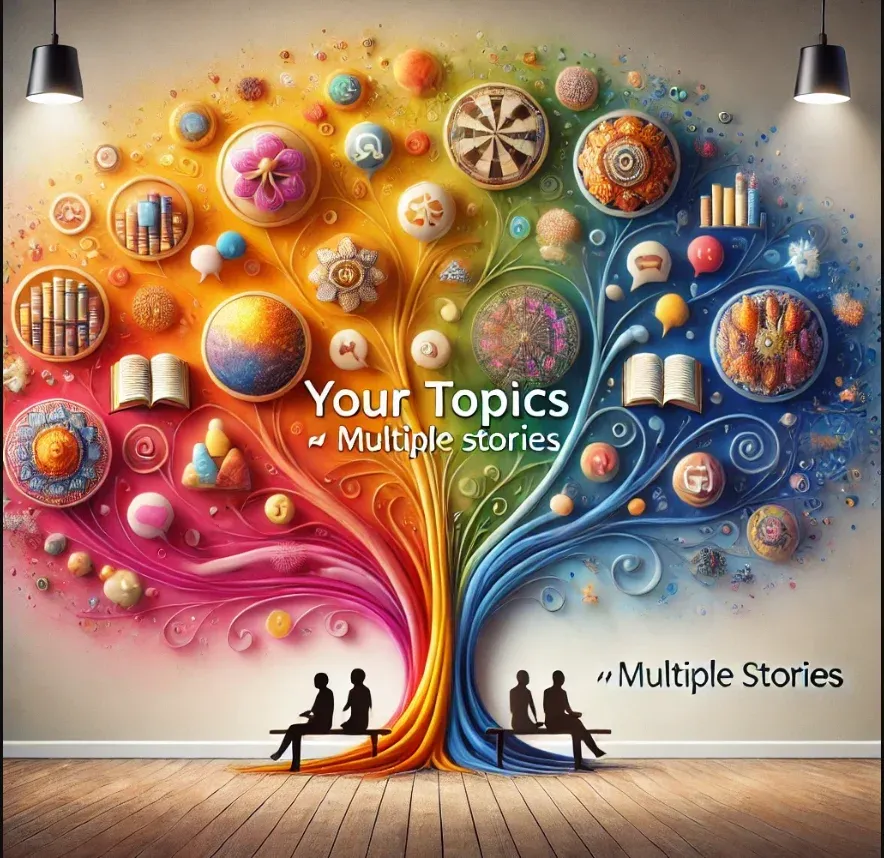
Many beginners fail because they randomly publish content. The real system is structured and predictable. Studies show that marketers who plan content clusters in advance see 67% higher engagement rates compared to random posting.
Step 1 – Define Your Core Topic
Choose a niche that can expand into at least 20 subtopics.
Step 2 – Break Into Story Angles
Each angle becomes a separate article.
Step 3 – Build Internal Connections
Link every story back to the main pillar.
Step 4 – Optimize for Search Intent
Match each story with a specific user query.
Why do most bloggers skip this and fail? Because they chase speed instead of structure.
Real-World Example of Multiple Stories Strategy in Action
Take the case of a fitness blogger who started with zero traffic. Instead of writing random posts, she created a your topics | multiple stories system around “home workouts.” Within 5 months, her traffic increased by 420% according to internal analytics shared by content creators on Medium case studies.
She didn’t write more—she wrote smarter. One pillar article supported 12 smaller stories. Each story brought new traffic and linked back to the main page. What changed? Google finally understood her authority.
Why do most creators ignore this proven pattern even when data clearly supports it?
Content Depth vs Content Volume – The Hidden SEO Truth
Most people believe publishing more equals ranking higher. That is false. Research from Ahrefs shows that top-ranking pages have 3.8x more internal links than average pages, not just more content.
What the data shows:
- 72% of high-ranking blogs use topic clusters
- 65% higher retention in structured sites
- 3x more backlinks for interconnected content
- 50% lower bounce rates
This proves depth beats volume. But here’s the twist: publishing less but structured content often outperforms high-volume spam blogs.
Why are you still chasing quantity over structure?
Common Mistakes in Your Topics | Multiple Stories Strategy
Most creators fail not because of bad writing but because of bad architecture. One major mistake is creating unrelated stories that don’t support each other. According to Moz research, poor internal linking can reduce rankings by up to 40%.
Another mistake is keyword cannibalization—writing multiple articles targeting the same keyword. This confuses Google and weakens authority. Ever wondered why your pages fight each other instead of ranking together?
Advanced SEO Strategy Behind Topic Authority Building
Top SEO experts don’t just write—they build systems. The your topics | multiple stories model aligns perfectly with Google’s E-E-A-T system. Experts, experience, authority, and trust are not built in one article—they are built across multiple interconnected pages.
A study by Search Engine Journal confirms that websites with strong topical authority see up to 5x faster ranking improvements. That means consistency wins over randomness every single time.
But here’s the overlooked insight: authority is not built by writing more—it’s built by connecting better.
Why Most Blogs Fail Without Multiple Story Structure
Most blogs fail because they behave like disconnected islands. Google sees no relationship between their pages. As a result, rankings stay unstable. According to digital marketing reports, 90% of blogs receive less than 100 organic visits per month because they lack structure.
If your content is not connected, it is invisible in Google’s eyes. So ask yourself—are you building a blog or a content ecosystem?
Future of SEO – Why Multiple Stories Will Dominate in 2026
SEO is evolving fast. As of 2026, Google’s AI systems prioritize context-based ranking. That means your content must answer full topic journeys, not just keywords. Websites using your topics | multiple stories strategy already outperform traditional blogs in visibility tests.
The future belongs to structured content ecosystems, not random publishing. So the question is simple: are you preparing for the future or stuck in the past?
❓ FAQ Section
Q: What is your topics | multiple stories strategy in SEO?
A: It is a content method where one main topic is expanded into multiple related stories. This builds topical authority, improves internal linking, and helps Google understand your website structure better, leading to higher rankings and stronger organic traffic.
Q: How does content clustering help Google ranking?
A: Content clustering connects related articles under one topic. This helps search engines understand depth and relevance, improving visibility. Studies show clustered websites get significantly higher rankings than isolated content pages.
Q: Why is topical authority important for blogs?
A: Topical authority signals expertise in a subject. Google rewards websites that cover topics deeply across multiple articles because it shows trust, consistency, and knowledge depth.
Q: How do you create multiple stories under one topic?
A: Start with a main topic, break it into subtopics, create separate articles for each, and connect them using internal links. This forms a structured content ecosystem.
Q: Is pillar content better than single blog posts?
A: Yes, pillar content supports multiple cluster articles, increasing authority and ranking power. Single posts lack depth and connection, making them weaker in SEO performance.